Wyoming License Plate: Registration, Types & Fees
Wyoming License Plate rules look simple until you try to read one. A leading number marks the county, the bucking-horse emblem has survived nine decades of redesigns, and the serial changes format with each new series. WYDOT sets the design and county treasurers issue the metal, collect the fee, and hand over the sticker. This page covers the current 2025 series, the fees in force this year, and the exact route to a plate without a second trip to the counter.
Wyoming License Plate details rarely come up until a sticker expires or a renewal card arrives in the mail. The plate itself carries more information than that, including a county code, a class designation, and a serial that follows statewide rules. Once you know what each part means, ordering a replacement, switching to a specialty design, or checking a used car becomes a short conversation instead of a research project. Everything below follows the statutes and fee schedule that apply this year.
How to Get a Wyoming License Plate
First-time registration happens at the county level, and the order of the two visits matters. The county clerk creates the Wyoming title, then the county treasurer registers the vehicle and issues the plate. Buyers who arrive at the treasurer with an out-of-state title are sent back to the clerk.
Title the Vehicle
Bring the signed title or Manufacturer’s Certificate of Origin, an odometer disclosure for vehicles from 2011 onward, and any lien paperwork to the county clerk. An out-of-state title requires a VIN inspection by a Wyoming law enforcement officer before the clerk can issue a Wyoming title.
Register With the County Treasurer
Take the new title, proof of insurance and payment to the treasurer in your county of residence. Sales and use tax is collected at this stage, at 5% to the state plus up to 2% in counties that levy an additional local tax. The office issues the plates, the validation sticker and a registration certificate on the spot. Drivers who are unsure which office handles their county can check the state list, which gives the address, phone number and office hours for all 23 counties.
Payment methods differ by office, though most accept cash, checks and cards. Card payments usually carry a service fee set by the county’s processor, often around 2.5%. Offices work normal business hours and close on state holidays, so a Monday morning visit is safer than a Friday afternoon one when a title has to be checked first.
Choose the Plate Type
Standard plates are assigned automatically. Specialty and prestige plates are requested separately, and the application can be filed at the treasurer counter or directly with WYDOT. The full catalogue, including the two new designs, is published by the state.
What to Bring
Counters turn people away for missing paperwork more often than for missing payment. A private sale from out of state needs one extra document compared with a dealer purchase, and the clerk’s office will not create a title until it is present.
- Signed title or Manufacturer’s Certificate of Origin.
- Proof of Wyoming insurance showing the VIN.
- Photo identification matching the title holder.
- VIN inspection slip for any out-of-state title.
- Odometer disclosure for vehicles from 2011 or newer.
- Payment for tax, title and registration fees.
Can You Apply Online?
First-time registration cannot be completed online. Wyoming has no statewide registration portal, and titles require an in-person or mailed transaction with the clerk. Several counties accept online renewal through their own payment providers, listed with each office on the state directory. Prestige plate requests are the main exception, since WYDOT accepts those applications directly.
What Is a Wyoming License Plate?
A Wyoming license plate is the metal tag issued to a registered vehicle in the state. It shows the plate number, the county prefix, the state name, and the current design series. Registration and plate issuance go together, since you cannot hold a valid plate without an active registration, and you cannot register a vehicle without a plate or a transfer. A plate follows the vehicle record, not the driver. When a car changes hands, the new owner registers it again in their own county, and the prefix usually changes with them. That is why a used car bought in Casper can carry a Natrona number for one owner and a Laramie number after the sale.
Who Issues Wyoming Plates
The Wyoming Department of Transportation sets design standards, approves specialty designs, and prints the plates. County treasurer offices handle the day-to-day work. That split matters when you need something done, because the state office will usually send you back to the county where the vehicle is registered.
- WYDOT Motor Vehicle Services: design, specialty plate approval, embossed plates, prestige plate orders.
- County treasurer: standard registration, fee collection, plate and sticker issuance, renewals.
- County clerk: titles and liens, which must be settled before a first registration.
That division is why two offices appear in almost every Wyoming registration guide. The clerk creates the title, the treasurer registers the vehicle and hands over the plate. Turnaround times follow the same split. Standard plates are normally handed over at the counter on the day of registration, because treasurer offices keep stock for each class. Specialty designs and embossed plates are printed by the state, so expect a mailing delay of several weeks. Prestige orders pass through a WYDOT application and review stage before the county receives the finished plate.
What the County Prefix Means
The number at the left of a Wyoming plate identifies the county where the vehicle is registered. Prefix 1 is Natrona County, 2 is Laramie County, 13 is Converse County, and the list runs to 23 for Sublette County. The order comes from property valuations recorded in 1930, not from population or geography. The prefix says nothing about the driver. It is a registration code, and federal privacy law keeps the owner’s name and address out of public plate searches. A plate number plus the county code can confirm where a car was registered, and that is where the public information ends.
Wyoming License Plate History
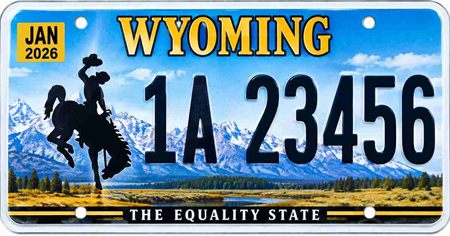
Few states tie a plate so closely to a single image. Wyoming has used the bucking horse and rider since 1936, and state law requires a new base design every eight years while keeping that emblem in the centre. The result is a plate that changes around a fixed symbol.
The Bucking Horse and Rider
Secretary of State Lester Hunt commissioned the design in 1935 to fight counterfeiting of the previous plate. Denver artist Allen T. True produced the drawing that appeared on every plate the following year. The horse is often linked to Steamboat, a famous bucking horse from the early 1900s, though historians have argued about the exact model for decades. State law keeps the emblem near the centre of the plate for most classes. Specialty designs place their organisation logo on the left side, which is why a University of Wyoming plate and a Wildlife Conservation plate look different at the edges but identical in the middle.
The Current Series
The 2024 and 2025 plates use a navy and gray rendering of the state flag with a red and white border. The word WYOMING sits at the top, travelwyoming.com appears at the bottom, and “That’s WY” is printed at the lower right. Registrants on two-year cycles received the new base first, and the rest of the fleet moved over during 2025. Older bases still appear on the road. The 2016 to 2024 plate showed Green River Lakes and Squaretop Mountain inside a yellow rope border, and the 2008 to 2016 plate carried the Teton Range. All remain valid until their registration expires. The visual change is easy to spot at a distance. The new base drops the landscape photo for a flat flag graphic, moves WYOMING to the top of the plate and adds two lines of small print along the bottom edge. Character size stayed the same, so a seven-character serial still fits without crowding the bucking horse.
Types of Wyoming License Plates
Wyoming issues plates in several classes, and the class decides the fee, the number of plates, and where you apply. The table below shows the main groups in brief, with the fee basis for each.
| Plate type | Issued by | Plates per vehicle | Base fee |
|---|---|---|---|
| Standard passenger | County treasurer | Two, front and rear | $30 state fee plus county ad valorem |
| Motorcycle, MPV, ATV | County treasurer | One, rear | $25 state fee |
| Trailer and camper | County treasurer | One, rear | $5 to $90 by unladen weight |
| Specialty | WYDOT with county treasurer | Two for passenger cars | $30 specialty fee plus registration |
| Prestige (personalized) | WYDOT | Two for passenger cars | $30 one-time |
| Antique, street rod, custom | WYDOT only | One, rear | Set by class, permanent in most cases |
| Commercial and apportioned | County treasurer, IRP for apportioned | Two for power units | By gross weight |
Read the table from left to right when you are planning a purchase.
- The class sets the fee you pay each year.
- The issuing office decides how long the wait runs.
- The plate count tells you whether the front bumper needs a bracket.
A pickup under 6,000 pounds usually sits in the passenger class, while the same truck registered for hauling drops into a weight-based fee instead.
Standard Plates
Every newly registered passenger car or light truck gets a standard plate unless the owner requests something else. Two plates are required, one on the front bumper and one on the rear. The rear plate carries the registration sticker, and the number stays with the vehicle while it is registered in Wyoming. When a car is sold, the plate usually comes off. Wyoming plates attach to the registration record rather than to the buyer, so the seller removes them and the new owner registers with a fresh set. Keeping a prestige or specialty number for the next vehicle requires the county treasurer to transfer it before the sale closes.
Specialty Plates
Specialty designs are created by the Legislature and administered by WYDOT. Each carries a base specialty fee on top of normal registration, and some add a donation to the benefiting program. Current options include University of Wyoming, Wildlife Conservation, Donate Life, Veteran, Purple Heart, Gold Star Family, National Guard, Pearl Harbor Survivor, Firefighter, EMT, Amateur Radio and Tribal plates. Two newer designs arrived in January. The Rodeo plate uses a historic photo of Steamboat and supports rodeo programs, while the Search and Rescue plate charges a higher first-year amount and a smaller renewal. Both must sell at least 1,000 plates by 2032 to stay in production.
Prestige Plates
Wyoming calls personalized plates “prestige” plates. You may choose up to five characters on a standard background, subject to availability and a review that rejects offensive combinations. The prestige charge is paid once for the life of the plate series rather than every year. Numbers already reserved by another registrant are not released until the reservation lapses. Availability moves every week, so a combination rejected today can open up after a registration expires.
Antique and Street Rod Plates
Vehicles that qualify as antique, street rod or custom can carry a restricted-use plate issued through WYDOT. These plates usually come with permanent registration, which removes the annual renewal but limits how the vehicle may be driven. The Pioneer plate is a separate class reserved for vehicles built before 1919. Only a rear plate is required.
Disability Plates and Placards
Disabled veteran plates waive registration fees on one vehicle when the applicant meets the service-connected disability threshold. Separate parking placards, permanent or temporary, are handled through WYDOT Driver Services rather than the county treasurer. A placard does not replace a plate; the vehicle still needs valid registration.
Commercial and Trailer Plates
Trucks registered by gross weight, apportioned vehicles under the International Registration Plan, and trailers all sit outside the passenger fee structure. Trailer fees follow unladen weight, from the lightest class up to the heaviest tier above 6,001 pounds. A permanent trailer registration is available for a one-time charge, which ends the annual renewal.
Wyoming License Plate Numbers and County Codes
A Wyoming plate number combines the county prefix with a serial. Passenger plates currently use formats such as 1-12345, 1A-1234 or 12-3456, depending on the series and county. The dash is a separator, not part of the number, and the serial identifies the vehicle record rather than the owner.
| Prefix | County | County seat |
|---|---|---|
| 1 | Natrona | Casper |
| 2 | Laramie | Cheyenne |
| 13 | Converse | Douglas |
| 22 | Teton | Jackson |
Those four prefixes cover the busiest registration offices in the state. The full sequence of 23 codes, from Natrona at 1 to Sublette at 23, is published by the state along with the county seat for each number.
Formats shift because counties run out of numbers at different speeds. Natrona and Laramie, the two largest issuers, moved through four-character serials years before smaller counties did. A plate with a letter in the middle is usually a later issue, and the state keeps the exact pattern on file for each series. Reading a plate in a parking lot tells you the registration county and nothing else. Owner details, addresses and driver records sit behind the Driver’s Privacy Protection Act and are released only for permitted purposes such as law enforcement, insurance claims or court proceedings.
Wyoming License Plate Fees
Two charges make up most Wyoming registration bills, namely a fixed state fee set by vehicle class and a county ad valorem fee based on the vehicle’s factory price. The state portion is easy to predict. The county portion depends on the vehicle’s age and original value, which is why two neighbours with the same model year can pay different amounts.
Standard Registration Fees
The state fee is fixed by vehicle class, so it does not move with the price of the car. A passenger car pays the same state fee regardless of what it cost when new. Weight and class decide the rest, which is why a trailer and a motorcycle land far below a pickup truck in the same county.
| Vehicle class | State fee | Notes |
|---|---|---|
| Passenger car and bus | $30 per year | Two plates issued |
| Motorcycle, MPV, ATV | $25 per year | One rear plate |
| Trailer up to 1,000 lb | $5 per year | Permanent option $350 |
| Trailer 1,001 to 3,500 lb | $30 per year | One rear plate |
| Trailer over 6,001 lb | $90 per year | Weight tiers in between |
| Electric vehicle surcharge | $100 per year | From 1 July |
| Plug-in hybrid surcharge | $50 per year | From 1 July |
The county adds 3% of the vehicle’s depreciated factory price. The state sets a service rate that starts at 60% of the original factory price in the first year and falls to 15% by the sixth year. A newer vehicle therefore carries a much larger county charge than the same model five years later, and the county fee has a statutory minimum.
Specialty and Prestige Fees
A specialty plate is a design fee, not a replacement for registration. You pay the normal state and county charges first, then the specialty amount on top. Prestige plates work the other way around, since the prestige charge is a one-time payment for the characters you chose, and it follows the plate through the rest of the series.
| Item | Fee | Charged |
|---|---|---|
| Specialty plate base fee | $30 | Each registration period |
| Veteran plate | $50 | Each registration period |
| Search and Rescue plate | $150 first year, $50 renewal | Added to registration |
| Prestige (personalized) plate | $30 | One time, valid for the plate series |
| Embossed version of a specialty plate | $50 | One time |
Specialty fees sit on top of the standard registration charge, so a specialty plate on a new car combines both. Prestige charges work differently, as the prestige amount is paid once and does not repeat at renewal. Embossing is a Wyoming-specific option that raises the characters and the bucking horse above the surface of the plate.
Replacement and Duplicate Fees
Replacement charges depend on whether you want the same number back. A new serial comes off the shelf and costs less because the county does not have to schedule a reprint. A duplicate keeps your existing number, which is useful for toll accounts, parking permits and insurance records, but it takes weeks and costs more.
| Transaction | Fee | What you receive |
|---|---|---|
| Replacement plate, new number | $8 | Next available serial, issued at the counter |
| Duplicate plate, same number | $30 | Reproduction, four to six weeks |
| Validation sticker set | $6 | Current year stickers |
| Duplicate registration certificate | $4 | Paper copy of the registration |
Choosing a new number is faster and cheaper, but it means updating your records with insurers, toll accounts and parking permits. Duplicates keep the number and cost more because the state has to reproduce the plate with the original serial.
Wyoming vs Neighboring States
Drivers moving into Wyoming often compare plate rules before they switch their registration. The differences that matter most are the number of plates required, the office that issues them, and whether owner data can be looked up.
| State | Plates required | Issuing office | Annual renewal | Owner lookup |
|---|---|---|---|---|
| Wyoming | Two, front and rear | County treasurer | Yes, in the registration month | No, protected by the DPPA |
| Colorado | Two | County motor vehicle office | Yes | No |
| Utah | Two | State DMV | Yes | No |
| Montana | One, rear only | County treasurer | Yes, permanent option available | No |
| South Dakota | Two | County treasurer | Yes | No |
Montana is the outlier for plate count, since it issues a single rear plate. Wyoming keeps two plates for passenger cars but allows one on motorcycles, trailers, multipurpose vehicles, antique vehicles and any car that was built without a front bracket. None of the five states release owner names from a plate lookup to the general public. Every one of them operates under the federal Driver’s Privacy Protection Act, which is why commercial lookup sites show vehicle details and never a registrant’s identity.
Wyoming Plate Rules and Display Requirements
A plate has to be readable from a normal distance, mounted where it belongs, and free of anything that changes how it looks. State law sets that standard, and county officers apply it at the roadside rather than at the counter. In practice most citations trace back to four frequent problems, and none of them involves a missing plate.
- Covers and tinted shields that hide characters.
- Frames that cover the state name or the serial.
- Expired or missing validation stickers.
- Bent, cracked or dirty plates that cannot be read.
Where Plates Must Be Mounted
Wyoming requires a plate on the front and rear of passenger vehicles, mounted horizontally and at least 12 inches above the ground. Motorcycles, trailers and multipurpose vehicles carry a single rear plate. Vehicles built without a front bracket, along with antique and street rod classes, are exempt from the front plate rule under the change that took effect in 2015.
Covers, Tint and Alterations
Anything that obscures the plate number, the state name or the validation sticker is a violation, even if the plate underneath is valid. Clear covers, tinted frames, dirt and bent metal all fall into the same category. Replace a damaged plate rather than straightening it, because a crease that crosses a character can be cited. Stickers belong in the corner the county marks, and they must be applied over the previous year rather than beside it. A stack of stickers that spills onto the plate face hides printed characters. Wyoming now allows an electronic copy of the registration as legal proof, though the physical sticker still has to be on the plate within 30 days of issuance.
Penalties for Wyoming Plate Violations
Plate offences are handled under Title 31 of the Wyoming statutes. The penalty depends on whether the problem is a missing or expired plate, an obscured plate, or a forged document.
| Violation | Statute | Maximum penalty |
|---|---|---|
| Driving without a valid plate or with expired registration | W.S. 31-4-101 and 31-4-104 | Fine up to $750 |
| Obscured, altered or unreadable plate | W.S. 31-4-101(a)(iii) | Fine up to $750 |
| Forged or counterfeit plate or registration | W.S. 31-4-102 | Felony, up to $5,000 and two years |
Fines for Missing or Expired Plates
Operating without a plate, or with a registration that lapsed, is a misdemeanour, and the general penalty provision sets the fine ceiling shown in the table above. There is no grace period after the registration month ends. Wyoming does not charge a late fee to renew, but the citation risk begins the day the sticker month closes.
Forgery and Counterfeit Plates
Falsifying a registration, making a counterfeit plate or knowingly using either is a felony. The statute allows a fine, up to two years in prison, or both. This is the one plate offence that leaves the traffic code and enters criminal territory. Repeat traffic convictions follow a separate schedule. The general traffic penalty section raises the maximum for a second conviction within a year, and again for a third, which can include jail time. Registration problems stack on top of those figures when the same stop produces both a plate violation and a moving violation.
Frequently Asked Questions
These five questions come up most often at county counters and in search results. Each answer is short on purpose, because the detail lives in the sections above.
How many digits are on a Wyoming license plate?
Current passenger plates carry five characters after the county prefix, in formats such as 1-12345 or 1A-1234. Older series used four characters. The prefix is separate from the serial, so the plate is read as county number plus serial rather than as one long number.
Does a Wyoming plate show the owner’s name?
No. A plate shows the county prefix, the class and the serial. Owner names, addresses and driver records are protected under the federal Driver’s Privacy Protection Act and are released only to permitted users such as law enforcement, insurers handling a claim or parties in litigation.
Do I need two plates in Wyoming?
Passenger cars and light trucks need a front and a rear plate. Motorcycles, trailers, multipurpose vehicles, antique vehicles and cars built without a front bracket carry one rear plate. The rear plate always holds the current validation sticker.
How much does a replacement Wyoming plate cost?
A plate with a new number is issued at the counter from available stock. A duplicate that keeps your existing number takes four to six weeks. Validation stickers and a duplicate registration certificate are handled as separate items.
Can I keep my Wyoming plate when I sell the car?
Plates are tied to the registration, not to the buyer. In most cases the seller removes the plate and the buyer registers the vehicle with a new one. If you want to keep a prestige or specialty plate for a replacement vehicle, ask the county treasurer before completing the sale.